
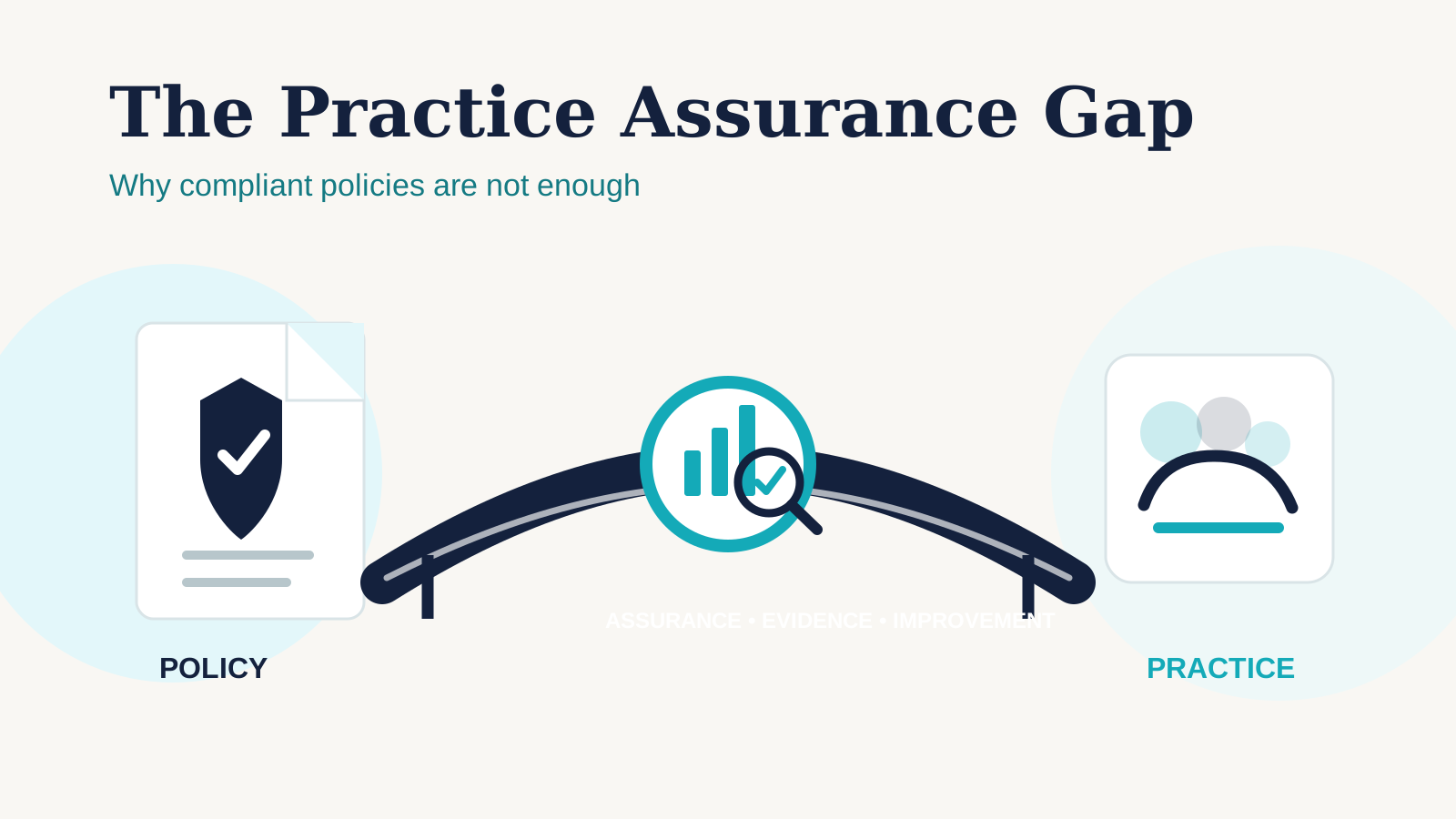
Human services organisations are carrying more compliance obligations than ever. Policies are updated. Training is recorded. Registers are maintained. Audits are completed.
But regulators, Boards and executives increasingly need to answer a harder question:
Can we demonstrate that our systems are actually working in practice?
That is the practice assurance gap.
What is practice assurance?
Practice assurance is the disciplined process of testing whether an organisation's policies, controls, governance arrangements and workforce expectations are being translated into safe, consistent and observable practice.
It moves beyond asking whether a policy exists or whether training was completed. It asks whether people understand what is expected, whether they apply it correctly in real situations, whether leaders can see where practice is drifting, and whether evidence supports the organisation's assurance claims.
For NDIS, aged care, child and family, out-of-home care, homelessness and community service organisations, this distinction matters because regulatory scrutiny increasingly reaches beyond documents into implementation.
Where the gap appears
The gap often appears in ordinary organisational measures that look reassuring on paper.
A policy is current, but staff describe the process differently.
Mandatory training is 100% complete, but capability has not been observed or tested.
An incident has been closed, but the same underlying risk remains.
Complaint numbers are low, but people using the service may not feel safe or confident to raise concerns.
An audit has been passed, but the Board receives little information about practice between audits.
A dashboard is green, but the measures report activity rather than whether services are safe, effective and consistent.
None of these automatically means an organisation is failing. They do mean leaders need better evidence before treating compliance indicators as assurance.
What regulators and auditors are looking for
Across Australian human services, regulatory frameworks increasingly emphasise implementation, governance oversight, risk management, workforce capability, consumer voice and continuous improvement.
The practical implication is that organisations need an evidence trail connecting requirements to real practice.
That evidence may include supervision records, competency assessments, file audits, incident analysis, complaints themes, consumer feedback, observations of practice, Board reporting, internal audits and documented improvement actions.
The strongest evidence is rarely one document. It is the pattern created when multiple sources tell the same story.
Five questions Boards and executives should ask
1. How do we know staff are applying our policies consistently?
Policy acknowledgement is not the same as implementation. Consider supervision, observation, competency checks, file review and reflective practice.
2. What evidence tells us our controls are working?
For each significant risk or regulatory obligation, identify what evidence would demonstrate that the control is operating as intended.
3. What are incidents, complaints and feedback telling us about practice?
These should not operate as separate registers. Together they provide intelligence about where systems, leadership or workforce practice may need attention.
4. Does the Board receive information about practice, not just compliance activity?
Reporting should help the governing body understand emerging risk, implementation quality and whether improvement actions are changing outcomes.
5. Where are we relying on assumption rather than evidence?
This is often the most useful question. It identifies areas where leaders believe something is happening but cannot yet demonstrate it.
Building a practical assurance system
Practice assurance does not require another layer of bureaucracy. The strongest systems use information organisations already collect, but connect it more deliberately.
Start by identifying the critical practices that matter most to safety, quality and regulatory compliance. Define what good practice looks like. Decide how it will be observed or tested. Determine what evidence will be retained. Set a review rhythm. Then ensure findings reach the people with authority to act.
The result should be a clear line from policy, to practice, to evidence, to governance oversight.
The regional and small-provider challenge
Small and regional human services organisations often carry the same complex safeguarding, governance and compliance obligations as much larger providers, without equivalent internal specialist capacity.
That makes proportionate assurance particularly important. The answer is not necessarily more systems. It is selecting the few controls and evidence sources that provide the clearest view of whether critical practice is safe and consistent.
The Planning and Practice Hub supports organisations across Grafton, Yamba, the Clarence Valley, Northern Rivers and Australia to strengthen governance, compliance, quality systems and practice assurance.
A useful place to start
Choose one high-risk area in your organisation and ask:
If the Board asked us today to prove that this policy is working in practice, what evidence would we show them?
If the answer is unclear, you have found a practice assurance gap worth examining.
The Planning and Practice Hub works with NDIS, aged care, child safe, OOHC, homelessness, community and not-for-profit organisations to connect policy, practice, evidence and governance assurance.
Free self-check
Find your Practice Assurance Gap
Use the free eight-question checklist to test where policy, practice, evidence and governance assurance may be disconnected in your organisation.